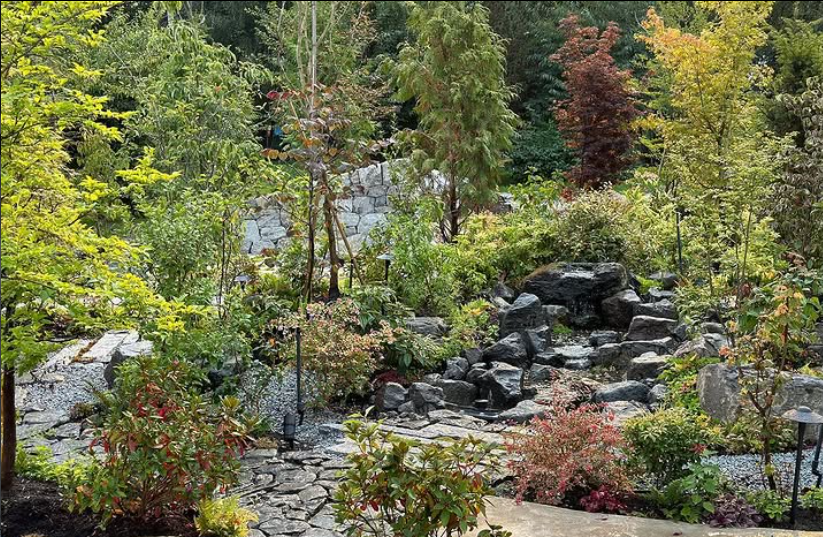
A Japanese-style garden can look deceptively simple. A few stones, restrained planting, a path, perhaps a water basin or bamboo screen—and the finished space may appear almost effortless. That simplicity is difficult to achieve because every visible element has to work harder. There is less clutter to hide poor proportions, drainage problems, or awkward material transitions.
For homeowners on the Pacific coast, the challenge becomes even more interesting. A garden inspired by Japanese design has to respond to local rain, shade, soil, existing trees, and residential construction. The best results are not replicas transported from another climate. They are site-specific systems that use Japanese design principles while behaving well in their actual environment.
Think of the Garden as a System
The easiest way to understand garden design is to divide it into layers. The first layer is structure: grades, drainage, retaining conditions, paths, walls, and major stones. The second is spatial organization: entrances, views, privacy, movement, and places to stop. Planting forms another layer, followed by details such as gravel, water, lighting, and seasonal accents.
Problems occur when those layers are tackled in reverse order. Choosing plants before resolving drainage, for example, can lead to replacements later. Installing a decorative gravel area without a plan for runoff, edging, or leaf fall can turn a crisp feature into a maintenance headache. The visible style should be the final expression of an underlying technical plan.
See also: Regain Control of Your Life With Drug Addiction Treatment
Design Rain Before Designing Gravel
Rain is not an occasional event in coastal British Columbia; it is a design condition. Before deciding where a dry-looking gravel composition should sit, consider where roof runoff arrives, which areas stay saturated, how water crosses hard surfaces, and whether neighbouring grades send water into the yard.
Japanese garden aesthetics often make water feel poetic, but the practical side is equally important. A dry creek can visually suggest a stream while also helping organize a low point. Permeable areas can slow runoff when they are detailed correctly. Stones can mark transitions and protect edges, but they should not become accidental dams that trap water against structures.
The point is not that every garden needs visible drainage infrastructure. Quite the opposite: good technical planning allows drainage to disappear into the composition.
Choose Plants for Form First and Suitability Immediately After
Plant selection in a Japanese-influenced garden is often less about collecting a long species list and more about building a few strong forms. An airy canopy, a compact evergreen mass, a ground layer, and one seasonal accent can create more clarity than a dozen unrelated specimens.
Local references for Japanese garden Vancouver design are helpful because they show how familiar West Coast conditions can be interpreted through Japanese composition rather than copied from a textbook image.
Suitability still comes first. Light exposure, mature size, soil moisture, root competition, and maintenance tolerance should narrow the options before aesthetics decide the winner. A plant that needs constant rescue will never contribute to a sense of calm.
This is also where restraint pays off. Repeating a few compatible plants can make a garden feel settled, while too many one-off specimens can make the same area feel like a nursery display.
Treat Stone as Structure
Natural stone is one of the most visually powerful materials in this kind of garden, which makes random placement especially noticeable. A boulder set on top of finished grade can look newly delivered even years later. Stone feels more convincing when its position suggests weight, age, and a relationship with the surrounding ground.
That may involve partial burial, grouping, grade changes, or orienting a stone according to its natural faces—judgments that designers trained on Kyoto’s heritage temple gardens learn to make by eye. On paths, stone selection also has practical consequences. Surface texture, spacing, and stability matter in wet weather. A beautiful stepping sequence that becomes slippery or uncomfortable is a design failure.
The same principle applies to retaining work. If stone is carrying soil or shaping a slope, its engineering role and visual role need to be considered together rather than sequentially.
Privacy Does Not Have to Mean a Blank Wall
Many Vancouver-area homes need screening from neighbouring windows, lanes or busy streets. The default solution is often a continuous opaque fence. It is effective, but it can flatten the garden into a box.
A more layered approach might combine a fence with planting, vary the degree of openness, or create a focal scene in front of the screen so that the boundary becomes background rather than the main event. Bamboo details can contribute to the visual language, but proportion and craftsmanship matter more than simply using the material.
Screening can also be selective. If one window is the problem, blocking that sightline may be enough. Keeping other views open can preserve light and visual depth.
Build for Maintenance You Will Actually Do
The phrase “low maintenance” is often misunderstood as “no maintenance.” Every garden changes. Leaves drop, plants grow, gravel moves, moss appears, and drainage systems need checking. The actual goal is to make maintenance predictable and compatible with the homeowner’s habits.
Design a garden needing precise, frequent pruning for a willing individual. A simpler planting palette may be better for a household that wants seasonal cleanup and little else. Consider nearby trees when choosing ground surfaces, as a pristine light gravel field beneath a heavy leaf canopy requires a very different maintenance routine than the same feature in an open courtyard.
The best design brief is therefore partly aesthetic and partly operational: how should the space look, and what level of care can realistically support that appearance?
A Local Garden, Not a Replica
Japanese garden design has a deep visual vocabulary, but its most transferable lesson is not a particular object or plant. It is the idea that site, material, time, and human movement should feel connected.
On the West Coast, that means working with rain instead of pretending it is not there, selecting plants that belong in the site conditions, using stone with structural logic, and designing views that work from inside the home and outside it. When those systems are resolved, the garden can feel quiet without feeling empty—and distinctly Japanese in spirit without becoming a stage set.