For most of automotive history, vehicles operated as largely independent machines. Drivers relied on road signs, personal judgement, and limited information about what lay ahead beyond the next bend or junction.
Today, that model is beginning to change.
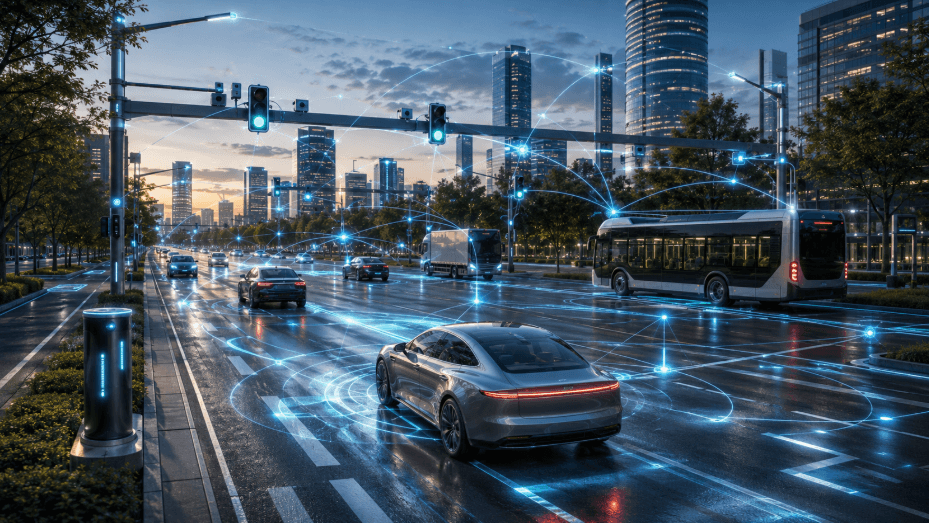
Modern vehicles are becoming increasingly connected, not only to their drivers but also to other vehicles, infrastructure systems, cloud platforms, and transportation networks. This growing web of communication is creating what some industry observers describe as an “Internet of Roads”—an interconnected environment where information flows continuously between the different elements of a transportation system.
While electrification often dominates discussions about automotive innovation, connectivity may prove equally transformative. The ability for vehicles and infrastructure to exchange information in real time has the potential to improve safety, reduce congestion, enhance efficiency, and fundamentally reshape how transportation networks operate.
The most significant changes may occur through systems that drivers rarely see at all.
From Connected Vehicles to Connected Networks
The first wave of connected vehicle technology focused primarily on convenience.
Navigation services, smartphone integration, remote diagnostics, and over-the-air software updates introduced new levels of digital functionality. These features improved the ownership experience but largely centred on communication between a vehicle and its owner.
The next phase is considerably more ambitious.
Instead of simply connecting drivers to their vehicles, emerging technologies aim to connect vehicles to each other and to the wider transportation environment. In this model, information becomes a shared resource that can help multiple road users make better decisions simultaneously.
The result is a transportation ecosystem that functions more like a coordinated network than a collection of isolated vehicles.
Vehicle-to-Vehicle Communication
One of the most important developments in connected mobility is vehicle-to-vehicle communication, often referred to as V2V.
The concept is straightforward: vehicles exchange information about their position, speed, direction, braking activity, and other operational data. This information can then be used to identify potential hazards before they become visible to drivers.
For example, a vehicle several cars ahead may detect an emergency stop. Through V2V communication, following vehicles could receive warnings before the driver is able to see the incident directly.
Similarly, connected vehicles could alert nearby traffic about road hazards, reduced visibility, or changing driving conditions.
The objective is not to replace driver judgement but to provide access to information that would otherwise remain unavailable.
By extending awareness beyond the immediate line of sight, V2V technology has the potential to improve both safety and traffic flow.
Infrastructure Is Becoming Part of the Conversation
Vehicles are only one part of the equation.
Road infrastructure itself is becoming increasingly capable of generating and sharing data. Traffic signals, road sensors, cameras, and connected monitoring systems can provide valuable information about current conditions across transportation networks.
Known as vehicle-to-infrastructure communication, or V2I, this technology allows roads and vehicles to exchange information in both directions.
A connected traffic signal might inform approaching vehicles about signal timing changes. Road sensors could communicate information about weather conditions, congestion, or temporary hazards. Infrastructure systems may even coordinate traffic flows dynamically to improve efficiency during peak travel periods.
Rather than reacting to conditions as they occur, drivers and vehicles gain access to predictive information that enables more informed decision-making.
This represents a significant shift in how transportation systems operate.
Real-Time Data Is Becoming a Transportation Resource
The foundation of the Internet of Roads is data.
Every connected vehicle generates information relating to location, performance, speed, environmental conditions, and system status. When aggregated responsibly and securely, this data creates opportunities to understand transportation networks with unprecedented accuracy.
Traffic management systems can identify congestion patterns more quickly. Emergency services may gain better visibility into developing incidents. Infrastructure planners can analyse usage trends and prioritise improvements more effectively.
The value of these systems often comes from scale. Individual data points may seem insignificant, but millions of connected interactions can create a detailed picture of how roads function in real time.
This information can then be used to improve efficiency across entire transportation networks.
See also: Tech!Espresso: Calgary’s Premier In-Home Computer Repair Experts
The Impact on Safety and Efficiency
Much of the enthusiasm surrounding connected mobility stems from its potential to address longstanding transportation challenges.
As these technologies continue to evolve, following the latest mobility trends can help businesses and transportation stakeholders understand how connectivity is reshaping the way vehicles, infrastructure, and digital systems interact.
Human drivers have limited visibility, delayed reaction times, and incomplete information about surrounding conditions. Connected systems can help reduce some of these limitations by providing earlier warnings and broader situational awareness.
Traffic efficiency may also improve. Vehicles receiving real-time information about congestion, incidents, or traffic signal timing can make more informed routing decisions. Over time, this could contribute to smoother traffic flow and reduced delays.
Importantly, many of these benefits do not require fully autonomous vehicles. Connected systems can provide value even when human drivers remain firmly in control.
In many respects, connectivity represents an evolutionary rather than revolutionary approach to improving transportation.
Building an Automotive Ecosystem Around Connectivity
The growth of connected mobility is influencing organisations throughout the wider automotive sector.
Manufacturers, software developers, infrastructure providers, insurers, fleet operators, and service companies are all adapting to a future in which data plays a central role in transportation. Even businesses involved in areas such as vehicle administration, compliance, and presentation, including Plates Express, increasingly operate within a digital automotive ecosystem shaped by connectivity, data management, and evolving customer expectations.
The Internet of Roads is therefore not simply a technological project. It represents a broader transformation in how the automotive industry functions and collaborates.
Challenges Remain
Despite its potential, connected mobility faces important challenges.
Data privacy, cybersecurity, infrastructure investment, and interoperability remain significant considerations. For connected systems to function effectively, vehicles and infrastructure from different manufacturers and jurisdictions must communicate reliably using shared standards.
Public trust will also be essential. Drivers must feel confident that connected technologies provide genuine benefits while protecting personal information and maintaining system security.
The success of the Internet of Roads will depend as much on governance and implementation as on technological capability.
Conclusion
The future of mobility is increasingly being shaped by connections that are largely invisible to drivers.
Vehicle-to-vehicle communication, smart infrastructure, and real-time data sharing are creating transportation networks that can respond more intelligently to changing conditions. These systems have the potential to improve safety, reduce congestion, and make travel more efficient without fundamentally changing how people interact with their vehicles.
While electrification remains a major force within the automotive industry, connectivity may ultimately prove just as transformative. The Internet of Roads is not a single technology or product but an evolving network of interactions that links vehicles, infrastructure, and information into a more coordinated transportation ecosystem.
As these systems continue to develop, the roads of the future may become not only smarter but also more connected than ever before.