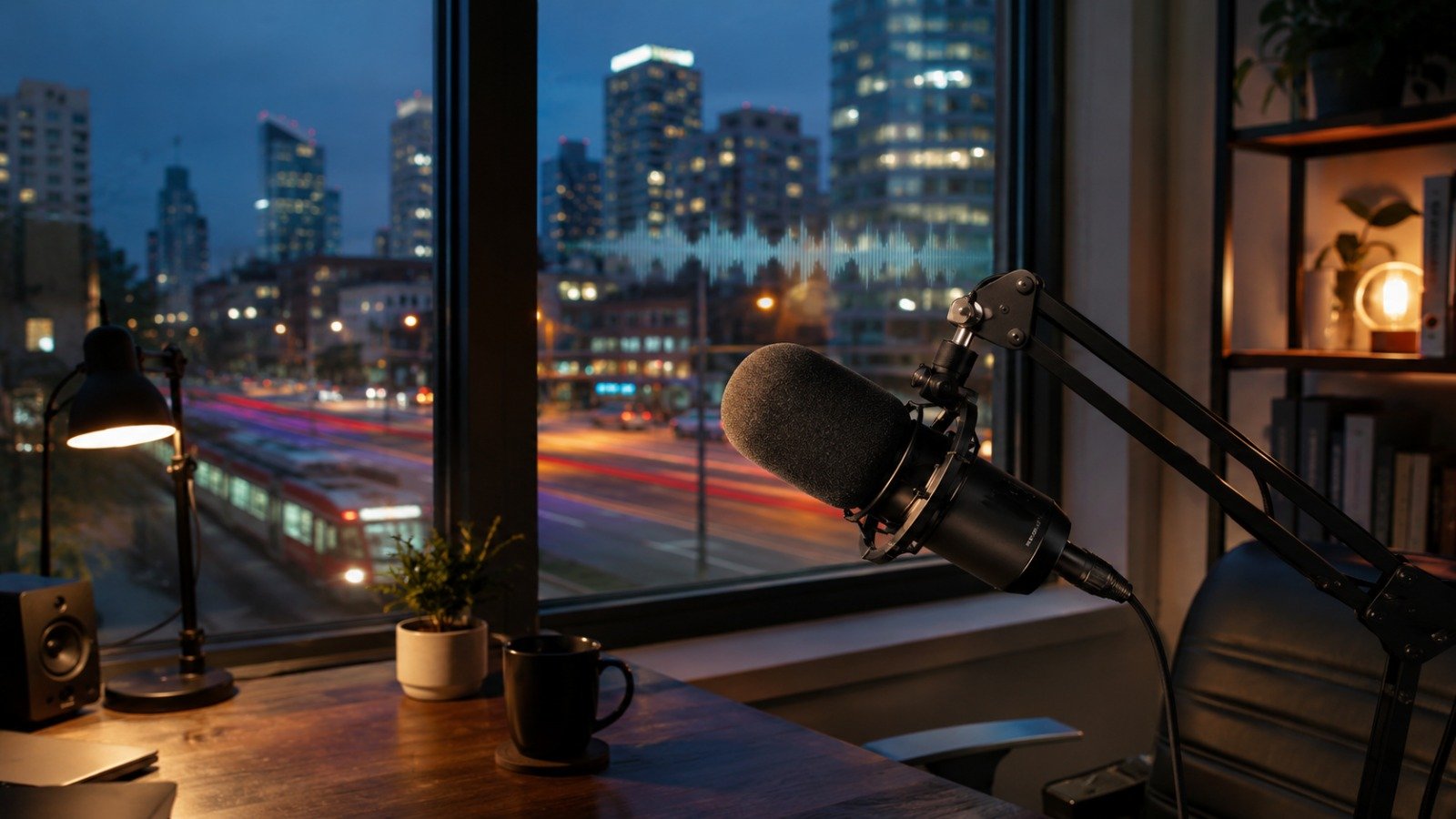
Most remote workers and home studio builders obsess over the capture side of the audio chain while ignoring the single largest acoustic weak point in any room. Glass is a terrible sound barrier. A standard single-pane window has a Sound Transmission Class (STC) rating of around 26 to 28, which means normal traffic noise passes through almost unimpeded. Even builder-grade double-pane units only push that to 28 to 32. For comparison, a typical interior drywall partition sits around STC 33, and you already know how well you can hear someone talking through a wall.
The Physics of Why Your Mic Picks Up Everything
Condenser microphones, and even cardioid dynamics to a lesser degree, do not discriminate. They capture the acoustic energy in the room, and noise entering through windows arrives as both airborne sound and structural vibration through the frame.
There are three variables that determine how much sound a window lets through:
Mass. Heavier glass blocks more sound. This is why laminated acoustic glass, which sandwiches a polyvinyl butyral (PVB) layer between two panes, outperforms standard glass of the same total thickness. The PVB layer also dampens resonance, which matters because glass has a coincidence frequency where it essentially becomes transparent to certain pitches.
Air gaps. The space between panes acts as a decoupling layer. Wider gaps perform better, which is why secondary glazing with a 100mm gap can outperform a sealed triple-pane unit for noise specifically. Asymmetric glass thicknesses (say, 6mm and 4mm panes) also help because each pane resonates at a different frequency, so neither amplifies the other.
Seals and frame quality. Sound is like water. It finds every gap. A premium acoustic window with a worn compression seal performs worse than a mid-range unit that is properly sealed. This is also why the install matters as much as the product.
Measuring Your Problem Before Spending Money
Do not guess. Pull out a sound level meter app (NIOSH SLM on iOS is properly calibrated for this, or use a $30 hardware meter for better low-frequency accuracy) and take readings at your desk during your noisiest typical hour. Then take a reading directly at the window glass. If the window reading is 6 dB or more above the room average, the window is your dominant noise path.
For the data-minded, run a frequency analysis. Traffic rumble lives in the 63 to 250 Hz octave bands, and that low-frequency content is exactly what cheap windows fail to block and what your noise suppression software (Krisp, NVIDIA Broadcast, Teams native suppression) struggles with most. Software gating chops intelligibility when it fights constant broadband noise. Fixing the noise at the boundary is always better than processing it out afterward.
The Upgrade Path, Ranked by Cost
Tier 1: Sealing (under $50). Acoustic caulk around the frame perimeter and fresh weatherstripping. This alone can recover 3 to 5 dB if your existing seals are degraded. It is the firmware update of window acoustics: free performance you should claim before buying hardware.
Tier 2: Heavy treatments ($100 to $400). Mass-loaded vinyl curtains or proper acoustic blinds. Useful, but they block light and only attenuate mids and highs. Truck rumble walks right past them.
Tier 3: Secondary glazing ($300 to $800 per window). An interior acrylic or glass panel mounted with an air gap. Genuinely effective, with 10 to 15 dB of improvement possible, but it complicates ventilation and looks like what it is.
Tier 4: Acoustic replacement windows. This is where the real gains live. Purpose-built units combining laminated glass, asymmetric pane thicknesses, and multi-chamber frames can hit STC 40 and above, which subjectively cuts perceived noise by more than half. If you are evaluating this route, the guide to soundproof windows published by Optima Windows and Doors breaks down STC ratings, glass configurations, and realistic decibel expectations in plain language, and it is one of the few resources that explains why dual-pane laminated units often beat triple-pane for noise specifically.
A decibel reference for context: a 10 dB reduction is perceived as roughly half the loudness. Going from STC 28 windows to STC 42 windows takes a 70 dB street down to background hum.
See also: Essential Services That Help Businesses and Individuals Succeed
The Tech Payoff
Once the boundary is fixed, everything downstream improves. Your noise gate threshold drops, so your voice stops getting clipped mid-word. Noise suppression algorithms work less aggressively, preserving the natural timbre of your voice. Voice assistants stop false-triggering on outside conversations. And if you record anything, podcasts, YouTube, course content, your noise floor drops low enough that you can actually use compression without pumping the street into the mix.
There is also a non-audio bonus: acoustic windows are by necessity well-sealed, multi-pane units, so they cut drafts and energy costs as a side effect. If you are in a noisy corridor of a major city, replacement is one of the few home upgrades that improves your work calls, your sleep, and your heating bill simultaneously. Homeowners in dense urban areas, where streetcar lines and arterial traffic run all night, get the most dramatic results, and established window companies in Toronto and other major centres now offer acoustic glass configurations as standard options rather than exotic custom orders.
Fix the room before you fix the chain. Your $300 mic will finally sound like it cost $300.