A harness sketch may show what an engineer wants without giving a manufacturer enough information to quote the build. The branches look clear, but the connector contacts are unnamed, the length has no measurement points or the test requirement says only “fully tested.”
A harness sketch may show what an engineer wants without giving a manufacturer enough information to quote the build. The branches look clear, but the connector contacts are unnamed, the length has no measurement points or the test requirement says only “fully tested.”
The supplier must then ask questions or base the quote on assumptions. A useful request for quotation (RFQ) makes the intended build clear while showing which decisions are still open. You do not need a finished production package to start a discussion, but you should distinguish an early estimate from a quotation for an agreed sample.
Give the drawing a clear measurement basis
When requesting prototype wire harnesses, include a drawing that shows the overall arrangement, branch locations and connector orientation. State the units, length reference points and tolerances, especially where the harness must reach a fixed connection or fit inside an enclosure.
A length measured between connector mating faces is different from a wire cut length. If the drawing does not identify what the dimension covers, the supplier cannot confidently translate it into a build requirement. Show the connector view, too, so the reader knows whether they are looking at the mating face or the wire-entry side.
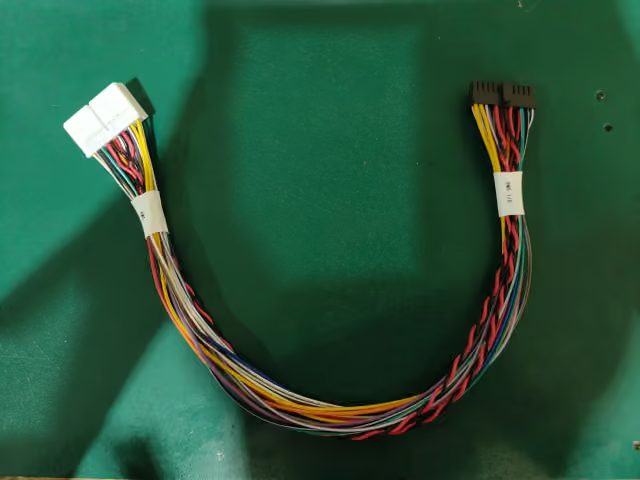
A photograph or physical sample can help explain routing and appearance. Use it alongside the drawing rather than expecting it to reveal hidden splices, contact part numbers or every dimension. Mark dimensions that are provisional and identify who will approve them before assembly.
Separate the connection map from the parts list
The drawing explains the shape. A pin-to-pin wire list shows where each wire starts and ends, including the connector and contact position, and identifies the wire specification. Give connectors consistent identifiers across the drawing and wire list.
Include splices, shield connections and intentionally unused positions. A connection labeled only “ground” may leave uncertainty about whether several wires meet at a splice or terminate separately. The supplier needs the actual connection arrangement to assemble and check it.
The bill of materials (BOM) identifies the parts needed for that arrangement. List connector housings and contacts separately, with any required seals, locks, sleeves and labels. Give specified components their exact part numbers. For wire, state the size, insulation and color; “standard red wire” leaves those choices open.
These documents should agree. If the wire list uses a different connector identifier or wire size from the BOM, resolve the difference instead of leaving the supplier to decide which file takes priority.
Make alternatives an explicit decision
Tell the supplier which parts are fixed and where alternatives may be proposed. “Equivalent connector acceptable” is incomplete if the connector must mate with a part already installed in your equipment.
For a proposed alternative, ask the supplier to identify the replacement part and explain any changes to mating, wire compatibility, dimensions or the assembly method. Keep your approval separate from the supplier’s suggestion. A quotation using an alternate should say so before it becomes the basis for a purchase order.
If you will supply components, identify those items and their quantities. If a part is unavailable, ask for that issue to be shown separately rather than allowing an unrecorded substitution. Material availability may change what the supplier can quote and which version of the design the sample will represent.
Explain what the sample must demonstrate
State whether the prototype is for an installation check, equipment operation or evaluation of the intended production configuration. This helps the supplier judge whether a temporary material choice is useful or would undermine the sample’s purpose.
Include the number of completed harnesses required and any extra specimens needed for testing that damages them. Keep a possible later production quantity separate from the prototype order so the supplier does not confuse the immediate build with a future program.
Give the required arrival date and delivery destination. If the sample must be built at a particular site, state that requirement.
See also: The Importance of Surveillance Systems in Business Security
Define testing and records before the quote
“Fully tested” does not tell the supplier what work to include. Specify the required electrical checks, inspection records and any application-specific validation. Have the responsible engineer define the conditions and acceptance limits; do not borrow test values from an unrelated harness.
If you invoke IPC/WHMA-A-620, identify the revision and acceptance class. Its public excerpt says the standard does not specify the frequency of in-process or end-product inspection. State what inspection coverage and reports you expect rather than assuming the standard name settles those questions.
Before accepting the quotation, check that it names the drawing, wire list and BOM revisions used. Ask the supplier to list unresolved questions, proposed substitutions and any excluded testing. The quotation should make clear which version of the sample will be built and what still needs your approval.